

Why pickleball suits indoor courts, and why we backed it
Pickleball has grown from a backyard game into one of the fastest growing sports in the United States, and it is growing quickly in Australia. What the numbers show, three cases for where Australian membership could go by 2030, why indoor courts suit the sport, and what makes a venue work.
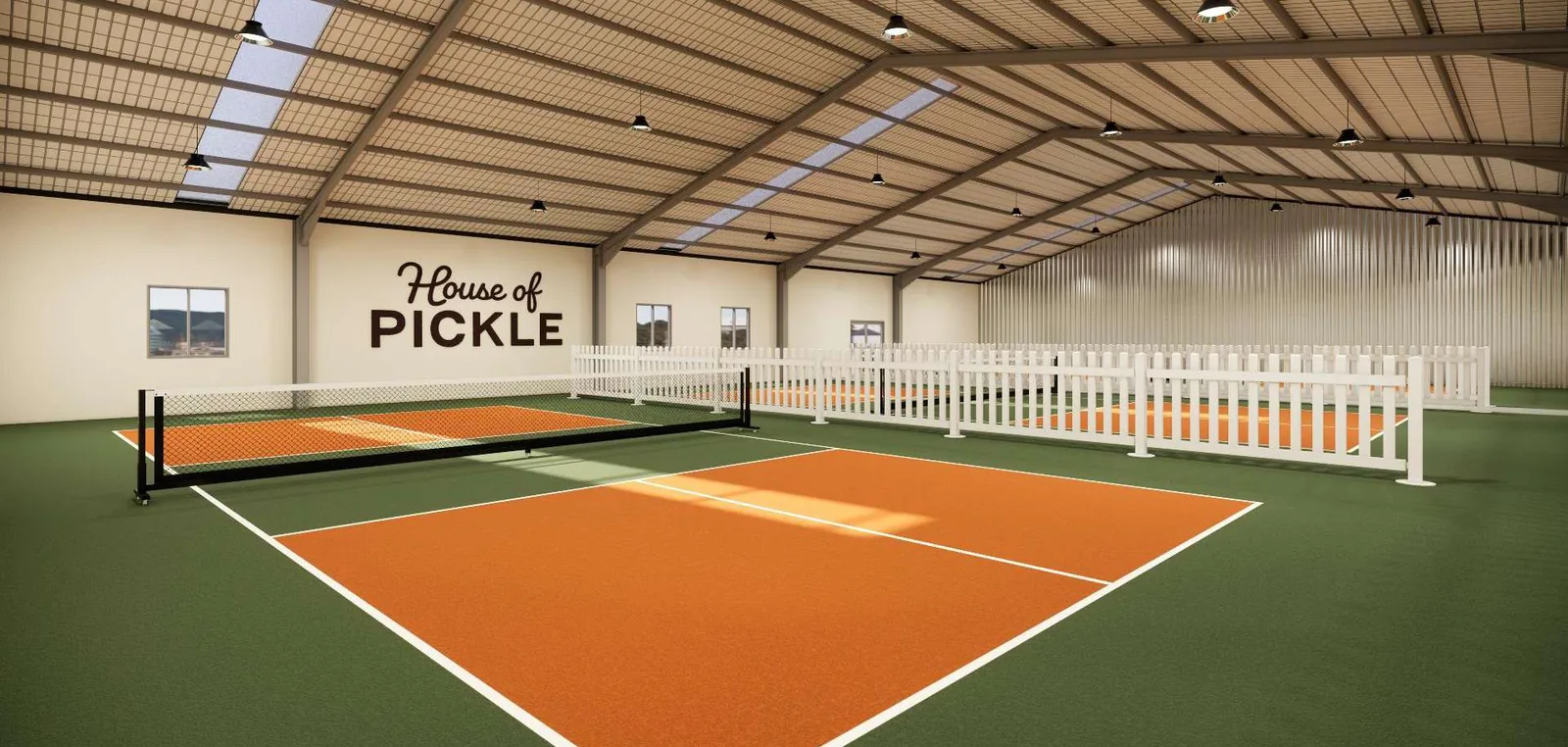
Pickleball was invented in the summer of 1965 on Bainbridge Island, near Seattle, by Joel Pritchard, Bill Bell and Barney McCallum, as a game their families could play together. Sixty years later it is one of the fastest growing sports in the United States and is growing quickly in Australia, and our first investment, House of Pickle Botany, will be a seven court indoor club built around it. This article sets out what we found when we looked at the sport as investors: how quickly it is growing, why it suits indoor venues, and what decides whether a venue succeeds.
- Americans who played pickleball in 2025
- 24.3 million
- SFIA
- Growth in American players between 2019 and 2025
- 7 times
- SFIA
- Australians aged 15 and over who played in the year to mid 2024
- 90,000+
- Australian Sports Commission
A simple game that travels well
Pickleball is played with solid paddles and a light, perforated plastic ball on a court of 6.1 by 13.4 metres, the size of a doubles badminton court and less than a third of the area of a doubles tennis court. The net is a little lower than a tennis net, the serve is played underarm or off a bounce, and players cannot volley from the area closest to the net, known as the kitchen. The result is a game built on placement and patience rather than power.
Those rules explain much of its appeal. The game is easy to learn, which is why venues can run sessions for first timers, and players of different ages and abilities can share a court without the game falling apart. It is often played as doubles, which makes it social by design: four people on a small court, close enough to talk.
The numbers in the United States
The United States is where the sport has grown furthest. Its numbers are a useful reference for where the game can go, although they are not a forecast for Australia.
Pickleball players in the United States have grown sevenfold since 2019
Americans aged six and over who played at least once in the year, millions
Show the figures
| Period | Players |
|---|---|
| 2019 | 3.5m |
| 2020 | 4.2m |
| 2021 | 4.8m |
| 2022 | 8.9m |
| 2023 | 13.6m |
| 2024 | 19.8m |
| 2025 | 24.3m |
Reading the chart
- What it shows
- The number of Americans who played at least once in the year rose from 3.5 million in 2019 to 24.3 million in 2025, about seven times as many. The fastest growth came in 2022, 2023 and 2024. Growth has since slowed in percentage terms, to about 23% in 2025 after 46% in 2024, but on a base this large it still added about 4.5 million players.
- What it means
- In our view, slower growth on a much larger base is what a sport looks like as it moves from early adopters to the mainstream, rather than a sign that it is fading. The more telling number for a venue is the regular player. Americans who played at least eight times a year grew from 1.4 million in 2020 to 7.5 million in 2025, yet about seven in ten players still played fewer than eight times.
- How to respond
- Build for the regular player while making it easy for the casual player to come back: sessions for first timers, social formats, leagues and memberships that turn one visit into a habit. And plan on growth slowing, as it has in the United States, rather than on recent rates continuing.
The age profile is changing too. Pickleball was long seen as a game for older adults, but the SFIA's 2026 report found that teenagers and young adults aged 13 to 24 now have the highest participation rates of any age group.
Australia is growing too, from a smaller base
Australia's figures are smaller and less complete, but the direction is similar. The Australian Sports Commission's AusPlay survey found more than 90,000 Australians aged 15 and over had played pickleball in the previous year when it reported in October 2024. In November 2025 it listed pickleball and padel, which it reports as one category, among the fastest growing physical activities for adults.
Membership of the national body shows the pace.
Pickleball Australia's membership grew more than fivefold in under three years
Members of Pickleball Australia at the dates the association reported them. The dates are not evenly spaced
Show the figures
| Period | Members |
|---|---|
| Jan 2023 | 4,000 |
| Dec 2023 | 8,000 |
| Feb 2024 | 10,000 |
| Nov 2025 | 23,000 |
Reading the chart
- What it shows
- Pickleball Australia began 2023 with just over 4,000 members and grew by 99.7% that year, to just over 8,000. It passed 10,000 members in February 2024, reported more than 15,000 in its 2023-24 annual report, published in December 2024, and put its membership at 23,000 in November 2025. Growth has slowed, from about 100% in 2023 to an average of about 60% a year between February 2024 and November 2025.
- What it means
- The sport is still growing quickly, and the pattern matches the American one: the rate falls as the numbers rise. Members are also only part of the market. Pickleball Australia itself counts more than 96,000 regular players against its 23,000 members, about four for every member, and AusPlay found that more than 90,000 adults had played at least once in the year to June 2024. Either way, most people who play are not members, and they are exactly the market a commercial venue serves.
- How to respond
- Treat national membership as a cautious measure of demand and the number of casual players as the opportunity. The growth that matters to a venue is local: how many people within a short drive already play, and how many of them can be turned into regulars.
How far could it go? The United States has about 12 times Australia's population, with 341.8 million people in July 2025 against 27.9 million in Australia in March 2026. Yet the SFIA counted about 270 times as many American players in 2025 as AusPlay counted Australian adults in the year to June 2024. The two surveys cover different ages and years, so the comparison is rough, but the gap is far too large to be explained by method alone. In our view, Australia is unlikely to reach American levels of participation soon, and its sporting habits are different. But even a fifth of the American rate would mean around 400,000 Australians playing.
How large could it become? Three cases to 2030
To give these numbers a shape, we built a simple model of Pickleball Australia's membership to 2030. It shows what different rates of growth would mean; it is not a forecast. It starts from the 23,000 members reported in November 2025 and assumes, as both the Australian and the American figures suggest, that growth keeps slowing as the sport gets bigger. The three cases differ in how quickly it slows, measured against the recent average of about 60% a year.
| Case | How growth changes | Growth in 2026 | Members in 2030 |
|---|---|---|---|
| Strong | Growth of 40% in 2026, two thirds of the recent average, then each year's rate is three quarters of the year before | 40% | About 67,500 |
| Central | Growth of 32% in 2026, about half the recent average, then each year's rate is 60% of the year before | 32% | About 45,000 |
| Weak | Growth of 15% in 2026 and 5% in 2027, then membership falls by 5% a year | 15% | About 23,800 |
Three cases for Pickleball Australia's membership to 2030
Members, thousands: the 23,000 reported in November 2025, then the end of each year. An illustrative model, not a forecast
Show the figures
| Period | Central | Strong | Weak |
|---|---|---|---|
| 2025 | 23.0 | 23.0 | 23.0 |
| 2026 | 30.4 | 32.2 | 26.5 |
| 2027 | 36.2 | 41.9 | 27.8 |
| 2028 | 40.4 | 51.3 | 26.4 |
| 2029 | 43.1 | 59.9 | 25.1 |
| 2030 | 44.9 | 67.5 | 23.8 |
Reading the model
- What it shows
- All three cases grow in 2026 and 2027. After that they part ways: about 67,500 members in 2030 in the strong case, nearly three times today's number; about 45,000 in the central case, nearly double; and about 23,800 in the weak case, close to today's level after peaking at around 27,800 in 2027.
- What would move it
- Upward: more indoor venues, leagues and coaching, schools and councils taking up the game, and more casual players becoming regulars. Downward: novelty fading among casual players, padel and other new sports competing for the same people and sites, more venues opening than local demand can fill, and household budgets squeezed by interest rates and fuel.
- How a venue plans for it
- Build the business so that it works in the weak case, where national membership barely changes and every new regular has to be won from another venue or brought into the sport. Treat the central and strong cases as upside: they would make a venue's job easier, but they should not be needed to cover the rent.
Members are only part of the market. If there were still about four regular players for every member, as Pickleball Australia reports today, the weak case would mean about 100,000 regular players in 2030, the central case about 190,000 and the strong case about 280,000. The ratio will change as the sport matures, so these are orders of magnitude rather than estimates.
What could cause a downturn
Every fast growing sport faces the question of whether its growth will last. These are the risks we see, and we would rather name them than pretend they do not exist.
- Novelty fading. Many people try pickleball once or twice. If fewer of them come back, the number of players can fall even while club membership holds up.
- Competition from other sports. Padel, which the Australian Sports Commission reports in the same category as pickleball, competes for some of the same players, sites and spending.
- Too many courts. If venues open faster than local demand grows, prices fall and the weakest venues close.
- Household budgets. With interest rates and fuel prices up, people may play less often or choose cheaper outdoor courts.
- Fixed costs. Like any venue, a pickleball club carries costs that do not fall when bookings do, which makes a quiet period expensive.
The signs we watch
- Membership. Pickleball Australia's membership reports, and whether growth keeps pace with the central case, which needs about a third more members in 2026.
- Participation. The Australian Sports Commission's AusPlay surveys, for the number of adults playing at least once a year.
- Off peak bookings. Whether demand reaches beyond the evening rush into mornings and afternoons.
- Leagues and tournaments. Entries show players committing for a season rather than a session.
- New venues. Openings for padel as well as pickleball show where competition for players will come from.
Why indoor courts suit the game
Pickleball can be played anywhere with a flat surface and a net, and many players start on outdoor courts shared with other sports. Indoor venues solve the problems that hold outdoor play back.
- Weather and daylight. Sydney's summer heat, winter evenings and wet days can cancel or cut short outdoor games. Indoors, a session booked is a session played, from early morning to late evening.
- A consistent game. A purpose built court has the right surface, even lighting and room to run. House of Pickle describes its Botany courts as having high ceilings and generous run-offs, which matter for a game built on lobs and quick movement.
- Neighbours. The sound of paddle on ball carries. Outdoor courts close to homes can attract complaints, and an indoor venue largely avoids the problem.
- More to sell. A dedicated venue can run beginner sessions, open play, leagues, coaching, court hire and functions on the same courts across the week, and a licensed area gives players a reason to stay after the game.
For a business, the most important of these is the first. An indoor venue that opens from 7am to 10pm, seven days a week, has a known number of court hours to sell every week of the year. That is what makes careful planning possible.
What makes a pickleball venue work
The economics of a venue come down to selling as many court hours as possible, at a fair price, with a cost base that is largely fixed. We explain that arithmetic in the economics of an indoor sports venue. In our view, five things decide whether a club succeeds.
- Location and access. Regular players may come several times a week, so travel time and parking matter more than they do for an occasional outing.
- A pathway for new players. Sessions for first timers turn curious visitors into regulars, and regulars into members and league players.
- Quality. Courts, lighting, run-off space and booking systems all show in how often people come back.
- Programming the quiet hours. Mornings and early afternoons have to be filled by different groups, such as retirees, schools, corporate teams and coaching, rather than by the same demand as evenings.
- Community. We believe the clubs that last are the ones people think of as their club, with familiar faces at the front desk and a reason to stay after the game.
Why we backed House of Pickle Botany
House of Pickle Botany brings these pieces together. It will have seven purpose built indoor courts on a floor of about 2,000 square metres, planned opening hours of 7am to 10pm every day, a licensed venue subject to liquor licensing, and parking on site. House of Pickle provides the brand and the systems the club will run on, and our directors take an active part: Mehul Sejwal is responsible for managing the club and its day to day decisions, Rohan Pandit for bringing in events, and Shivam Rathi for overseeing operations and working with House of Pickle. The club is targeting an opening in the first week of December 2026, subject to the fit out and the necessary approvals.
Conclusion
Pickleball in Australia has moved past its earliest stage but is still small. Membership of the national body has grown more than fivefold since the start of 2023, and in all three of our cases it keeps growing through 2027. Beyond that the range is wide, from roughly today's level to nearly three times it, and nobody can yet say which path the sport will take.
In our view, that range points to a clear way to build and run a venue. Design it for the regular player, give casual players reasons to come back, earn from more than court hire, and plan the business so that it works even if growth stalls. A club built that way would benefit from the strong case without depending on it. We will report on House of Pickle Botany's progress, including the numbers we can share, in the Newsroom.
Sources
- SFIA, U.S. pickleball participation
- SFIA, 2026 Pickleball Single Sport Report released
- The Dink, SFIA participation figures 2019 to 2024
- Pickleball.com, SFIA report confirms over 24 million Americans playing
- Australian Sports Commission, New sport research, October 2024
- Australian Sports Commission, New AusPlay data released, November 2025
- Pickleball Australia, 10,000 members
- Pickleball Australia, Annual Report 2023-24
- Pickleball Australia, A new look for Pickleball Australia, November 2025
- USA Pickleball, History of the game
- Pickleball.com, Pickleball court dimensions and setup
- House of Pickle, Botany
- U.S. Census Bureau, U.S. population growth slows, January 2026
- ABS, National, state and territory population, March 2026
This article is general information about Threefold Capital and the businesses it follows. It is not financial advice, and it is not an offer or an invitation to invest. The views are the firm's own at the date of publication.